
Datadog vs. New Relic (2026): An Honest Buyer's Guide
Datadog vs New Relic compared on pricing, APM, infrastructure, logs, RUM, OpenTelemetry, AI, security, and TCO—with worked cost scenarios for buyers.
Last verified: August 4, 2026. Prices below are public list prices, not negotiated quotes. Contract terms, committed volume, support, retention, region, and overages can materially change the result; confirm the current offer with each vendor before signing.
Quick verdict
Don't have time for 5,000 words? Here's the whole argument in four bullets:
- Pick Datadog if you want a broad observability-and-security platform — 1,000+ integrations, tightly connected alert-to-telemetry workflows, Cloud SIEM, and a generally available AI incident investigator in Bits AI SRE. Accept that the bill grows with every product you switch on, and that cost predictability is its weakest trait.
- Pick New Relic if cost transparency and a low-friction start matter more: no per-host charges, a genuinely useful free tier (100 GB/month ingest + one full-platform user, forever, no credit card), and first-class OpenTelemetry ingestion under its normal data and compute meters. Accept that full-platform seats at $349/user/month become the bottleneck as your engineering headcount grows.
- On cost, there is no universal winner. In the worked scenario below (100 hosts, 8 full-platform users, 5 TB/month), New Relic comes out cheaper under the stated assumptions; increase the full-platform user count to 50 and the seat model reverses the result. The math is in Section 5.
- On security breadth, Datadog has the clearer lead today. It ships Cloud SIEM, runtime workload protection, code security, and a FedRAMP High-certified government environment; New Relic's public positioning is more compliance- and observability-led.
Both are Leaders in the 2025 Gartner Magic Quadrant for Observability Platforms — Datadog for the fifth consecutive year, New Relic for the thirteenth. You're not choosing between good and bad. You're choosing between two different ideas of how an observability bill should behave.
At a glance
| Datadog | New Relic | |
|---|---|---|
| Best for | Teams wanting observability + security + AI ops in one platform | Teams wanting predictable, consumption-based pricing and a free start |
| Pricing model | Per-host + per-feature stacking | Per-user + data ingest (or Compute + ingest) |
| Free tier | No (14-day trial) | Yes — 100 GB/mo + 1 full-platform user, forever |
| Infrastructure | $15–23/host/month | No per-host charge |
| APM | $31–40/host/month, stacks on infra | Included via ingest + user license |
| Logs | $0.10/GB ingest + $1.70/million events indexed | $0.40/GB all-in, everything searchable |
| User seats | Unlimited, free | Full-platform: $349/user/month (Pro, annual) |
| AI agent | Bits AI SRE — GA since Dec 2025 | SRE Agent — preview since Feb 2026 |
| OpenTelemetry | Supported; product meters, metric types, and included allotments still apply | Native ingestion; normal data and compute meters still apply |
| Security | Cloud SIEM, workload protection, code security, CSPM | Compliance-focused; Security RX in preview |
| FedRAMP | High (certified) | Moderate (High on roadmap) |
| Gartner MQ 2025 | Leader, 5th straight year | Leader, 13th straight year |
Related guideDatadog vs Grafana Cloud 2026: Buy the Platform or Assemble the Stack?→
1. The real difference: how each one bills you
Feature lists make these two look interchangeable — APM, infra monitoring, logs, RUM, synthetics, AI investigation, the works. The meaningful difference is philosophical, and it shows up on your invoice.
Datadog sells modules. One proprietary agent, one backend, and roughly twenty-plus products that each add a billing dimension: infrastructure monitoring is the foundation at $15–23/host/month, APM stacks $31–40/host/month on top, logs bill twice ($0.10/GB to ingest, then $1.70/million events to index), custom metrics beyond 100 per host cost $0.05/metric/month. The workflow payoff is real — alert, trace, logs and host metrics are one click apart because everything shares a backend — but so is the compounding. Datadog also bills infrastructure on a high-water mark: the maximum of the lower 99% of hourly host counts, calculated at month-end. A sustained spike can affect the billable count, although Datadog excludes the top 1% of hourly usage. Users, at least, are free and unlimited — every engineer can read everything.
New Relic sells access and data. Its rebuilt backend, NRDB, stores logs, metrics, traces and events in one telemetry database, queried with one language (NRQL). Billing has exactly two dimensions: data ingest ($0.40/GB standard, $0.60/GB Data Plus, with 100 GB/month free) and user type — Basic users are free, Core users run about $49/month, and Full Platform users who can touch APM, infrastructure and digital experience cost $349/month on Pro (annual). Hosts, containers, serverless functions: unlimited, unbilled. There's also an escape hatch — a Compute pricing model that swaps per-user fees for Compute Capacity Unit charges — aimed at teams whose headcount outgrows their data volume.
So the two platforms create symmetric anxieties. Datadog's bill compounds with features × hosts × data. New Relic's bill compounds with engineers who need full access. A 100-person engineering org on New Relic Pro pays $34,900/month in seat fees before a single byte of telemetry lands — a scenario where Datadog's free-seats model wins by default. Flip it around — a Kubernetes fleet that autoscales to thousands of nodes — and Datadog's per-host, high-water-mark model punishes you while New Relic doesn't notice. Which anxiety you'd rather live with is the actual decision.
2. Head-to-head: six rounds
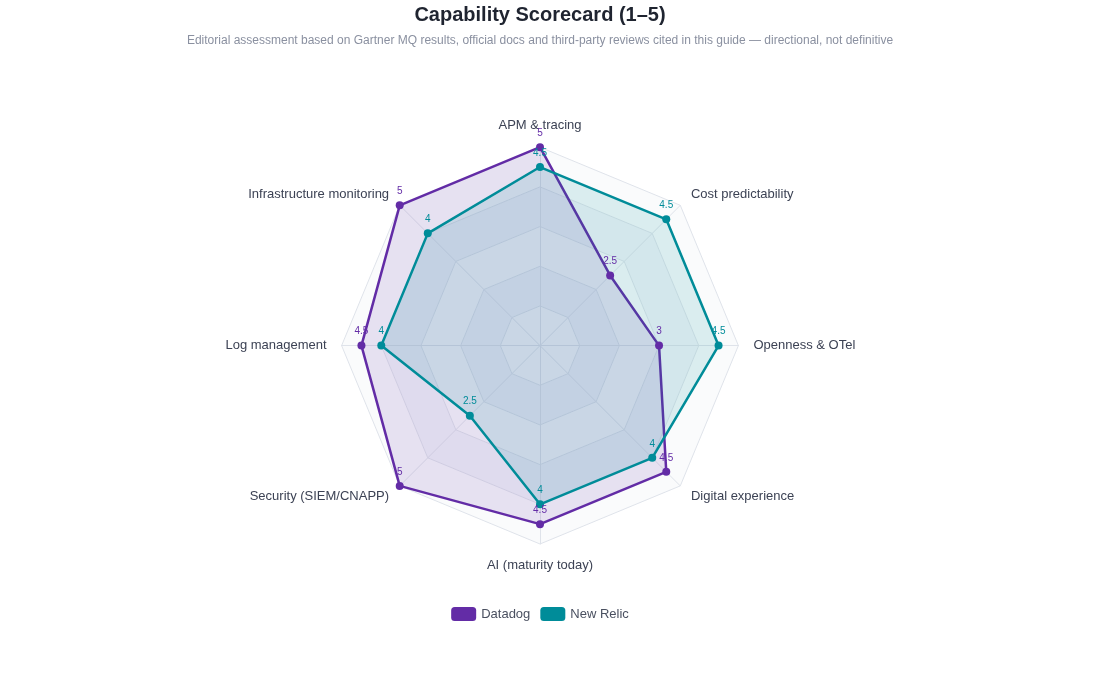
Here's our editorial scorecard, then the evidence round by round. Scores are directional judgment calls based on the sources cited throughout this guide, not lab measurements.
Round 1 — APM & distributed tracing
Both are top-tier APM products; this is what each company was built on. Datadog's toolkit is deeper at the margins: Continuous Profiler for function-level CPU and memory attribution, Dynamic Instrumentation to add logs and metrics to a running production service without redeploying, and seamless frontend-to-backend correlation because RUM and APM share a backend. New Relic counters with two instrumentation paths — language agents with genuinely useful thread-level profiling, plus an eBPF agent (eAPM) for zero-code Kubernetes instrumentation — and Infinite Tracing, which accepts 100% of trace data for teams that can't tolerate sampling blind spots. New Relic treats OpenTelemetry as a first-class ingestion path. OTel does not make the platform free: the resulting telemetry still counts toward New Relic's data and, where applicable, compute meters.
Winner: Datadog, narrowly — deeper profiling and a tightly correlated troubleshooting experience. If your org is OTel-native or sampling-averse, call it a draw.
Round 2 — Infrastructure monitoring
Datadog invented this category among the two and it shows: deep Kubernetes support, network performance monitoring, cloud cost management, and the 1,000+ integration library that covers almost anything you'd run. The catch is the pricing mechanics discussed above — per-host fees, high-water-mark billing, and cardinality that converts into custom-metric charges. New Relic's infrastructure monitoring is solid rather than spectacular — agent-based host metrics, no-agent cloud integrations for AWS/Azure/GCP, 30 days of raw retention plus 13 months of rollups — but its billing model is structurally friendlier to dynamic fleets: unlimited hosts, with high-cardinality telemetry affecting data volume rather than creating a separate per-host charge. One caveat: deep APM and infrastructure troubleshooting requires the appropriate user access; model how many engineers truly need Full Platform access instead of assigning it to everyone by default.
Winner: Datadog on depth; New Relic on economics at scale. For autoscaling Kubernetes estates, New Relic's no-per-host model can be attractive; the actual gap depends on ingest, retention, compute, and user access.
Round 3 — Log management
Two philosophies, two failure modes. Datadog's two-tier billing — $0.10/GB ingest plus $1.70/million events indexed — lets you ingest everything and index selectively, which keeps costs down until an incident forces you to pay rehydration fees to search your own archives. In the source model used for this guide, a 100 GB/day workload with the assumed event size and index ratio approaches $107K/year before APM or infrastructure; change either assumption and the result moves. Its query experience, though, is best-in-class: faceted search, log pattern clustering, sensitive data scanning, and seamless trace correlation. New Relic makes every ingested log queryable with no separate indexing tier and supports configurable retention up to seven years; the default for logs is much shorter and extended retention is paid. It charges $0.40/GB, four times Datadog's ingest rate, once you pass the free 100 GB/month. Low search-to-ingest ratio favors Datadog; "everything must be searchable" favors New Relic's predictability.
Winner: tie. Datadog wins on query experience and low index ratios; New Relic wins on predictability when most logs must stay searchable.
Round 4 — Digital experience monitoring
The most even round. Both platforms cover browser and mobile RUM (iOS, Android, React Native, Flutter), session replay and synthetic monitoring, and both were named Leaders in the 2025 Gartner Magic Quadrant for Digital Experience Monitoring — Datadog positioned highest for ability to execute, New Relic for the second consecutive year. Datadog's suite extends further into Product Analytics and experimentation, with smoother backend correlation, but bills each component separately (RUM Measure lists at $0.15 per thousand full-traffic sessions annually, while Investigate and Session Replay use higher, separate meters). New Relic folds DEM into its unified ingest pricing and captures Core Web Vitals, rage-click and dead-click detection out of the box.
Winner: tie. Datadog if you want product analytics bolted on; New Relic if you want it bundled.
Round 5 — AI and agents
The most current round, and the one where timing matters. Datadog shipped first: Bits AI SRE reached general availability in December 2025 — when an alert fires, it investigates autonomously, querying traces, logs and recent deploys to produce a root-cause hypothesis before you open your laptop — and is sold through Datadog's AI credit model. Datadog has since expanded the family (security analyst, code assistance, an MCP server that's now GA).
New Relic shipped broader, but later: its Agentic Platform — a no-code, drag-and-drop builder for custom AI agents with orchestration, RBAC governance and a continuous evaluation engine — launched in preview in February 2026 alongside an SRE Agent that performs full-stack diagnostics using Intelligent Root Cause Analysis over an entity topology graph, and works inside Slack and Zoom during triage. New Relic's 2026 AI Impact Report claims AI-feature users resolve incidents 25% faster, and its Workflow Automation component is already GA. The honest caveat: as of mid-2026, New Relic's flagship agent pieces are still preview, while Datadog's equivalent has been production-ready for over half a year.
Winner: Datadog today (GA beats preview). Watch New Relic — the no-code agent builder is a capability Datadog doesn't yet match, and if it lands well, this round flips.
Round 6 — Security & compliance
Not close. Datadog operates a full security platform woven into its observability data: Cloud SIEM, runtime Workload Protection, App & API Protection, Code Security (SAST/IAST/SCA, secret scanning), and CSPM — and its government offering achieved FedRAMP High certification earlier this year. New Relic's security story is compliance-led — SOC 2, HIPAA via the Data Plus tier, FedRAMP Moderate with a stated plan to reach High — and its vulnerability-correlation feature (Security RX) only entered preview in 2026. If "observability + active threat detection in one pane" is on your requirements list, only one of these vendors qualifies today.
Winner: Datadog, decisively.
3. Pricing: the math that actually decides this
List prices, side by side
| Line item | Datadog | New Relic |
|---|---|---|
| Infrastructure monitoring | $15–23/host/mo (annual) | None — hosts are free |
| APM | $31–40/host/mo, stacks on infra | Included in ingest + seats |
| Log ingestion | $0.10/GB | $0.40/GB (100 GB/mo free) |
| Log indexing | $1.70/million events (15-day) | None — all logs searchable |
| Custom metrics | $0.05/metric/mo beyond 100/host | N/A — counts toward ingest |
| Full-platform access | Free, unlimited users | $349/user/mo (Pro, annual) |
| AI incident investigation | Bits AI SRE: $500/mo per 20 investigations | SRE Agent: preview, pricing TBD |
| Free tier | 14-day trial only | 100 GB + 1 full-platform user, forever |
Two worked scenarios
Scenario A — mid-size SaaS team: 100 hosts, 8 engineers needing full access, 5 TB/month telemetry. Datadog runs roughly $8,200+/month ($1,500 infrastructure + $3,100 APM + ~$3,600 logs). New Relic runs roughly $4,750–7,200/month (~$1,960 ingest + $2,792 seats + an external on-call tool if you need one). Under these assumptions, New Relic wins by a wide margin. This is an editorial scenario, not a vendor quote or a universal savings claim.
Scenario B — same infrastructure, bigger team: 50 engineers need full-platform access. Datadog's bill doesn't move (seats are free). New Relic adds $17,450/month in seat fees alone, pushing the total to roughly $19,410/month — more than double Datadog. The crossover is stark:
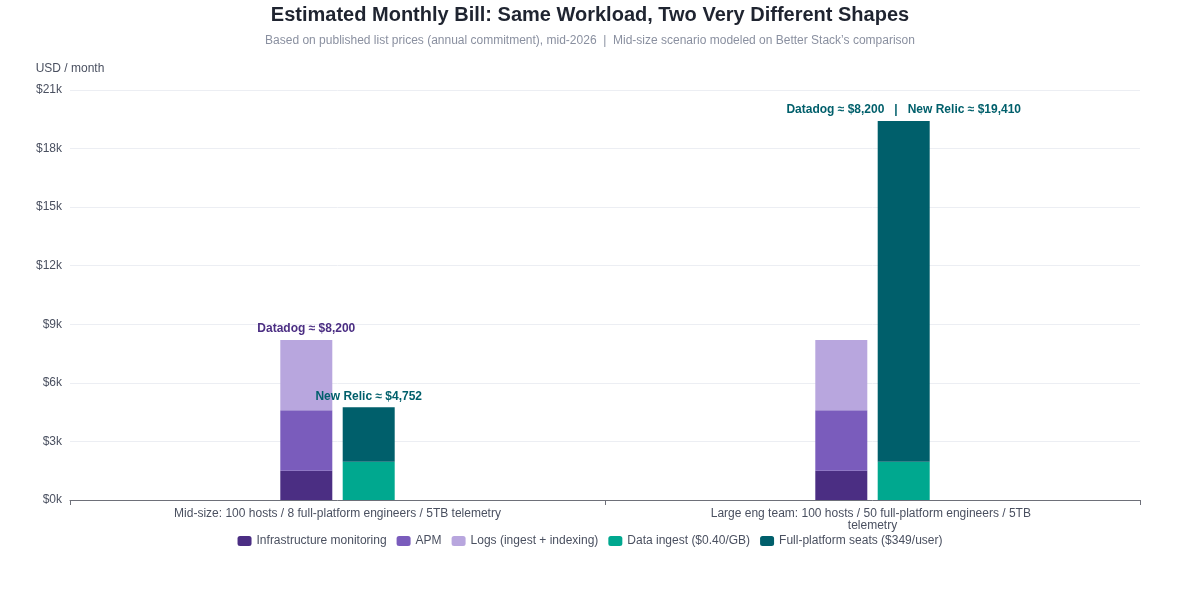
The rule of thumb that falls out of the math: many hosts, few engineers → New Relic. Many engineers, modest infrastructure → Datadog. And if you're a three-person startup, New Relic's free tier is the only offer in this comparison that can cost $0 for real production use within its included limits.
The bill-shock files
Each platform has its own folklore. Datadog's greatest hits: high-water-mark billing locking a month at peak capacity; agents deployed per-pod in Kubernetes turning every pod into a billable host; a single high-cardinality tag (say, customer_id) exploding into tens of thousands of custom metrics at $0.05 each; and on-demand usage priced above some committed annual rates. "Our Datadog bill is 3x/5x/10x what we budgeted" is a perennial thread in engineering communities.
New Relic's are quieter but real: seat costs scaling linearly with every engineer who touches an incident; ingest at 4x Datadog's per-GB rate punishing teams that don't trim telemetry at the source; and a subtler organizational cost — deep APM and infrastructure troubleshooting depends on the assigned user type, so access policy becomes part of incident design.
4. Pros and cons
| Datadog — strengths | Datadog — weaknesses |
|---|---|
| Broadest platform: 1,000+ integrations, observability + security in one backend | No real free tier; evaluation is a 14-day trial |
| Best-in-class correlated troubleshooting (alert → trace → logs → host) | High-water-mark billing; spikes set the month's rate |
| Deepest profiling (Continuous Profiler, Dynamic Instrumentation) | Custom-metric and OTel surcharges punish high cardinality |
| Real Cloud SIEM + runtime security; FedRAMP High certified | Complex, multi-dimensional invoices; weakest cost predictability in category |
| Bits AI SRE is GA and production-proven | Per-product query syntaxes; status pages and on-call are extra SKUs |
| Unlimited free users — everyone sees everything | No self-hosted option |
| New Relic — strengths | New Relic — weaknesses |
|---|---|
| Most generous free tier in the category (100 GB + 1 full user, forever) | $349 full-platform seats restrict access at scale |
| Transparent two-dimensional pricing; no per-host, no high-water mark | Ingest at $0.40/GB is 4x Datadog's ingest rate |
| Unified NRDB backend + one query language (NRQL) across all signals | NRQL is proprietary — months of dashboards become switching costs |
| OpenTelemetry is a first-class ingestion path | No Cloud SIEM; security offering is compliance-led |
| All ingested logs searchable, 7-year retention, no rehydration | SRE Agent & Agentic Platform still in preview (as of mid-2026) |
| No-code AI agent builder (Agentic Platform) is genuinely differentiated | No status pages, no native on-call/phone/SMS — you'll buy PagerDuty too |
5. What users actually say
Third-party review aggregators and community threads show recurring themes, but they are directional evidence rather than controlled tests. Datadog earns its highest marks for innovation speed, feature breadth and dashboarding; its recurring one-star themes are cost scaling and a learning curve that comes from sheer option count. New Relic earns its best reviews for platform cohesiveness, UI quality and APM accuracy — users are frequently surprised by how usable the free tier is — while complaints cluster around NRQL's learning curve, customization limits, and sticker shock when ingest isn't governed. On G2, the two sit within a tenth of a point of each other (~4.4 vs ~4.3 out of 5), which tells you the review sites won't make this decision for you.
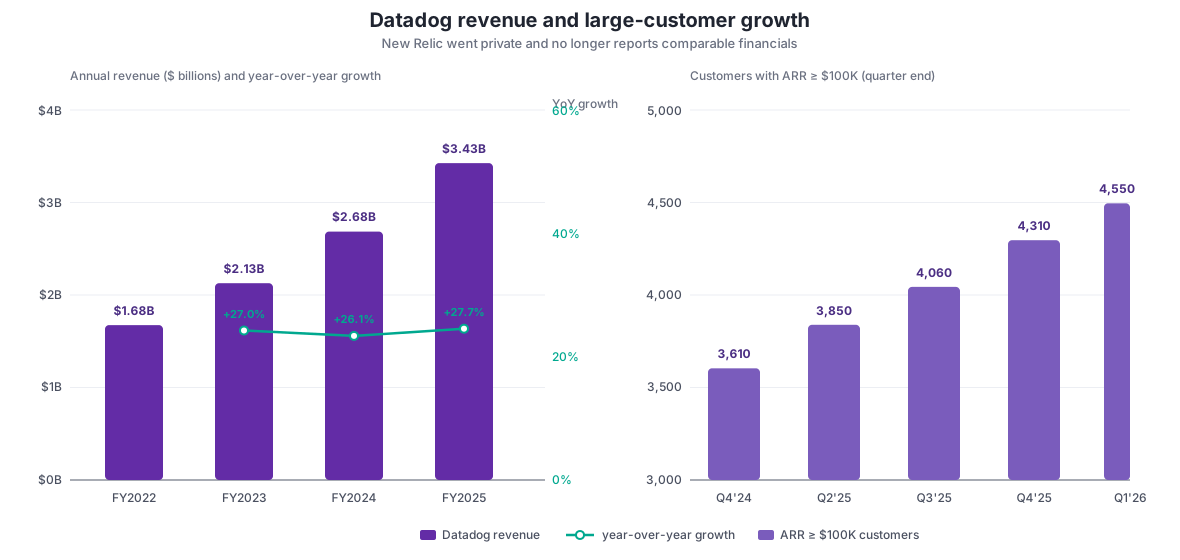
The corporate backdrop is worth a glance, since you're buying a multi-year relationship. Datadog is a public company in full growth mode: Q1 2026 was its first billion-dollar quarter ($1,006M, +32% year over year), with roughly 4,550 customers above $100K ARR, FedRAMP High certification for its government offering, and full-year guidance raised to $4.30–4.34B. New Relic went private in a $6.5B take-private in late 2023 and no longer discloses financials; its public signals are product cadence (Agentic Platform in February 2026, a slate of AI-observability releases at its June 2026 event) and its 13th consecutive Gartner Leader placement.
6. So, which one should you choose?
Choose Datadog if:
- You want one platform for observability and security (Cloud SIEM, runtime protection, code scanning) — today, not on a roadmap.
- Your environment is complex and heterogeneous, and the 1,000+ integration library plus tightly correlated troubleshooting can save your team real hours.
- Your engineering org is large and everyone needs incident visibility — free, unlimited seats beat $349/user math.
- You need AI incident investigation in production now (Bits AI SRE is GA) or FedRAMP High for public-sector work.
- You have the FinOps discipline to govern custom metrics, indexing and host sprawl — or the budget not to care.
Choose New Relic if:
- You're cost-sensitive or starting from zero — the free tier runs a small production stack for $0, no credit card.
- Your infrastructure is large, dynamic or Kubernetes-heavy, and per-host/high-water-mark billing would punish your autoscaling patterns.
- You've standardized on OpenTelemetry and prefer a data-ingest model instead of Datadog's product-specific metric types and allotments.
- You want all ingested logs queryable without a separate indexing tier and are prepared to price the retention period you need.
- Your full-platform user count is small enough that seats stay cheaper than Datadog's per-host stacking — or you're willing to explore the Compute model.
Whichever you choose, do three things first. One: inventory your real numbers — peak host count, monthly GB of logs/traces/metrics, and the honest list of engineers who need full access; those three numbers decide the pricing question better than any review (including this one). Two: run both against real traffic — New Relic's free tier and Datadog's 14-day trial make a two-week bake-off cheap, and your own invoice estimate beats any list-price arithmetic. Three: prefer OpenTelemetry where it fits — both platforms can receive OTLP data, but a migration still requires validation of semantic conventions, dashboards, alerts, sampling, service topology, retention, and incident workflows.
7. FAQ
Is Datadog or New Relic cheaper?
Neither, universally. New Relic can be cheaper for mid-size teams with few full-platform users under the public list-price model used here; Datadog becomes cheaper as the number of engineers needing full access grows, because its seats are free. Model your own host count, data volume and headcount before believing either vendor's TCO deck.
Does New Relic really have a free tier? What's the catch?
Yes: 100 GB/month of ingest, one full-platform user and unlimited basic users, forever, no credit card. The catches: usage beyond the included 100 GB requires an upgrade, and only one Full Platform user is included; additional user access and retention can add cost.
Which is better for Kubernetes?
Both are strong. Datadog's K8s monitoring is deeper (cluster agent, network and security layers); New Relic's can be cheaper at scale because hosts and containers are not separate billing units; telemetry volume and access still need to be governed. Autoscaling-heavy clusters usually save meaningfully on New Relic.
How do their AI features compare right now?
Datadog's Bits AI SRE has been generally available since December 2025 and can investigate firing alerts; usage is packaged through Datadog AI credits. New Relic's SRE Agent and no-code Agentic Platform launched in preview in February 2026 — architecturally broader, but not yet GA as of August 2026.
Can I use OpenTelemetry with both?
Yes — both ingest OTLP natively. The difference is billing: New Relic meters the resulting OTel data through its ingest and compute model, while Datadog applies its product meters, metric types, and included allotments; high cardinality matters in both cost models.
What about on-call and status pages?
Is my data locked in?
Partially, on both sides. Dashboards, alerts and runbooks accumulate in proprietary query languages (Datadog's per-product syntaxes, New Relic's NRQL) — the longer you stay, the higher the switching cost. OpenTelemetry reduces collector and SDK lock-in, but dashboards, alerts, queries, entity models, sampling rules, and operating workflows still need migration work.
The bottom line
This comparison isn't really Datadog versus New Relic — it's module-stacking versus usage pricing. Datadog bets you'll pay for broad product coverage and tightly connected workflows while accepting a bill that compounds with each added meter. New Relic bets you'll trade some of that breadth for pricing you can explain to your CFO in one slide, plus a free tier that lets you start today.
Run your three numbers — hosts, gigabytes, full-access engineers — through both models. The answer usually reveals itself in the spreadsheet. And if it's genuinely close, let the tiebreakers decide: security and GA-proven AI say Datadog; open instrumentation, cost predictability and a $0 start say New Relic.
This guide is for general informational purposes only and does not constitute procurement, legal or financial advice. Prices reflect published list prices as of August 2026 and change frequently; Gartner Magic Quadrant placements are not endorsements. Confirm current pricing and feature availability with both vendors before purchasing.
Sources
- Datadog public price list
- Datadog billing documentation
- Datadog product allotments
- Datadog for Government achieves FedRAMP High certification
- Datadog Q1 2026 financial results
- New Relic pricing
- New Relic usage-plan list prices
- New Relic data retention documentation
- New Relic Agentic Platform announcement
- Better Stack: Datadog vs. New Relic
- Middleware: Datadog vs. New Relic
Vendor pages describe their own products and should be read as primary documentation, not independent performance tests. The scorecard and cost scenarios in this guide are editorial models built from the cited public information.

Contact us
Join the community

to join the community
Try Guance
Start online and pay only for what you use.
Get startedChoose a Guance plan