Automotive Observability

Connect vehicle apps, connected services, and enterprise systems in one investigation

Correlate configured mobile experience, API traces, logs, cloud and Kubernetes resources, and production-system evidence so automotive teams can locate the boundary affecting a driver journey, connected service, or business process.

Operational outcomes to validate

Reduce tool switching during cross-system investigation

Connect app experience with APIs and dependencies

Give internal teams and suppliers shared evidence

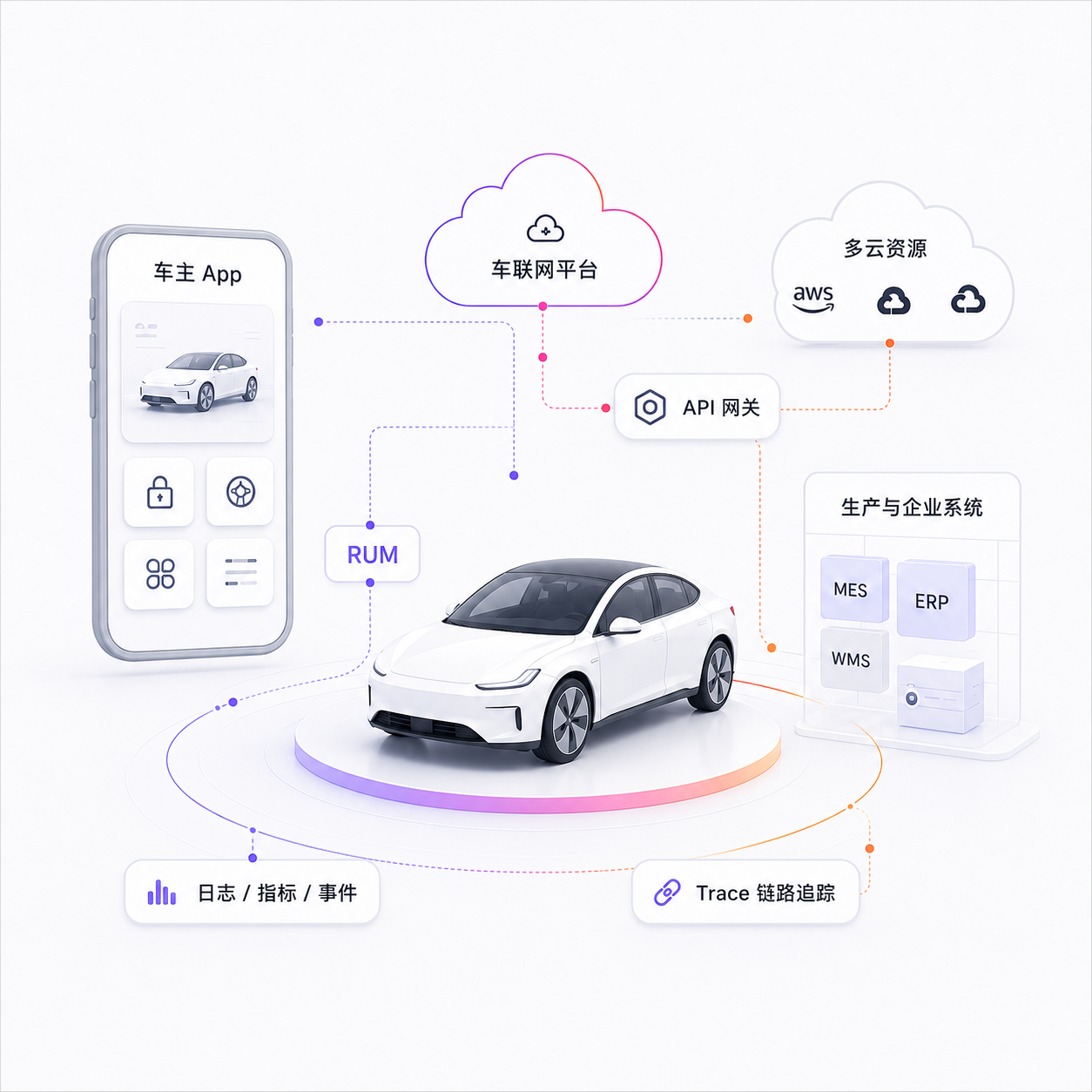
Real automotive incidents cross apps, connected platforms, cloud resources, and enterprise systems

Preserve the affected journey and time range while moving through configured user, service, runtime, and business-system evidence. Each collection path and control remains explicit.

Connected vehicle applications, platforms, enterprise systems, and observability data flow
01

App login is slow or a remote-service request fails

Observed symptomUsers report loading loops or failed requests while app, gateway, and service teams see different dashboards.

Evidence to inspectSupported Mobile RUM, Session Replay, gateway logs, Java traces, Redis or MySQL metrics, and Kubernetes events.

ResponseNarrow the affected version, region, request, service, or dependency and hand off a reproducible evidence set.

02

A release affects only part of the connected-service population

Observed symptomAfter a rollout, selected versions or regions show slower updates, failed operations, or increased support cases.

Evidence to inspectVersion, region, device-safe dimensions, request duration, error codes, queue lag, service errors, and resource state.

ResponseTest whether the evidence points to a release, congestion, backlog, capacity, or dependency before rollback or scaling.

03

MES, WMS, ERP, or dealer workflows become intermittent

Observed symptomProduction, inventory, ordering, or after-sales workflows time out across several organisational boundaries.

Evidence to inspectApplication logs, host or container metrics, middleware state, traces, slow queries, alert events, and cloud-resource evidence.

ResponseGive IT, operations, business-system owners, and suppliers one timeline with an explicit responsibility boundary.

Representative systems and technology boundaries

Vehicle-owner apps and mini apps

Login, remote-service requests, appointments, commerce, membership, and support journeys.

Gateways and microservices

API gateways, Java or Spring services, service APIs, and third-party dependencies.

Containers and middleware

Kubernetes, Kafka, Redis, MySQL, Nginx, and their configured telemetry.

Production and enterprise systems

MES, WMS, ERP, dealer systems, and supplier interfaces where supported data is available.

Carry the investigation context from symptom to response

1

Confirm the affected user, region, app version, screen, action, and request in supported RUM evidence

2

Follow configured Trace context through gateways, services, databases, middleware, and third-party dependencies

3

Compare logs, metrics, events, resources, releases, and alerts on the same time range

4

Assign the evidence and recovery check to the responsible engineering, operations, enterprise-system, or supplier team

What automotive observability should answer

Is the issue in the app, gateway, service, dependency, cloud resource, or enterprise system?

Automotive digital journeys span mobile clients, connected-service platforms, APIs, middleware, databases, cloud resources, and enterprise applications. Guance links the telemetry that each layer is configured to expose so teams can test the failing boundary without claiming direct vehicle-control coverage.

Driver-facing experience

Segment supported app journeys by version, region, network, screen, action, and request.

Service dependencies

Follow configured traces through gateways, services, databases, messaging, and third-party APIs.

Cross-team response

Preserve time, scope, evidence, ownership, and recovery checks for internal teams and suppliers.

Build an end-to-end automotive investigation path

Unify the evidence from connected-service and enterprise platforms

Unify the evidence from connected-service and enterprise platforms

Bring supported metrics, logs, traces, infrastructure, Kubernetes, cloud-resource, and business telemetry into a shared context. Model system boundaries explicitly so a common view does not imply identical collection or automatic correlation everywhere.

Follow an affected mobile journey into backend services

Follow an affected mobile journey into backend services

Use supported Mobile RUM and Session Replay evidence to identify the affected app version, region, screen, or request, then continue into configured gateway and service traces, logs, and dependencies while applying privacy controls.

Coordinate investigation without losing data boundaries

Coordinate investigation without losing data boundaries

Use role-based access, masked fields, incidents, alerts, snapshots, and shared investigation context to give engineering, operations, business-system teams, and suppliers the evidence appropriate to their responsibilities.

Frequently asked questions

Which automotive systems can Guance observe?

Coverage depends on the supported telemetry each system exposes. Typical evaluation paths include mobile apps, API gateways, microservices, Kubernetes, cloud resources, logs, databases, and enterprise applications.

Can a mobile issue be followed into backend services?

Yes, when supported Mobile RUM and backend trace propagation are configured. Teams can preserve request and service context as they move from the client into traces, logs, and runtime evidence.

Does this solution monitor or control vehicle functions directly?

No such universal claim is made. Guance analyses configured observability data from supported digital and IT systems; direct vehicle telemetry and control depend on the customer architecture, interfaces, and safety governance.

Bring one driver journey, connected-service dependency map, access boundary, and failure scenario to design the proof of value