Contact us

Join the community

Scan with WeChat
Join the official community group

Try Guance

Start online with usage-based pricing and a true cloud service.

Get started

Choose a Guance edition

Code repositories

GuanceDB / Observability Data Engine

GuanceDB3.0

A unified observability data lake with fully separated storage and compute

Pain points

Surveillance scenarios are changing, but the underlying systems are still stuck in the past

As business evolves, the data accessed by the observable platform is no longer limited to basic monitoring metrics, but also includes application logs, links, user experience, and business data. As data scale, query concurrency, and retention cycles continue to grow, traditional architectures tightly coupled with computing and storage tend to encounter bottlenecks in scaling efficiency and resource utilization.
There are a large number of duplicate queries in dashboards, monitors, and daily troubleshooting. GuanceDB 3.0 identifies query patterns suitable for pre-aggregation, builds aggregated results during the data write phase, reduces the overhead of high-frequency queries repeatedly scanning raw data, and schedules query resources according to actual load.

Upgrade

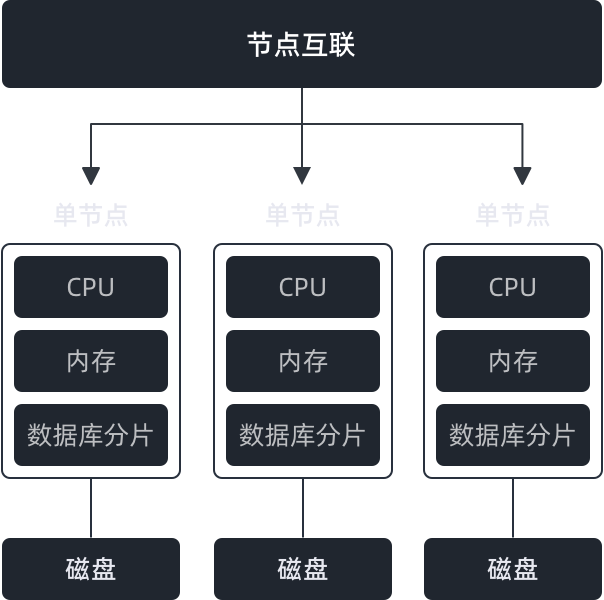
Traditional MPP architecture vs. GuanceDB 3.0

This is a comparison between the traditional MPP architecture and the GuanceDB 3.0 architecture, highlighting how after decoupling storage and compute, query resources can be independently scheduled according to business loads, offering more flexible choices between performance, cost, and resource isolation.

Traditional MPP architecture

Computing and storage are tightly coupled, with limited scalability. Computing resources are difficult to adjust dynamically, overall utilization is low, and expansion costs are high.

Traditional MPP architecture

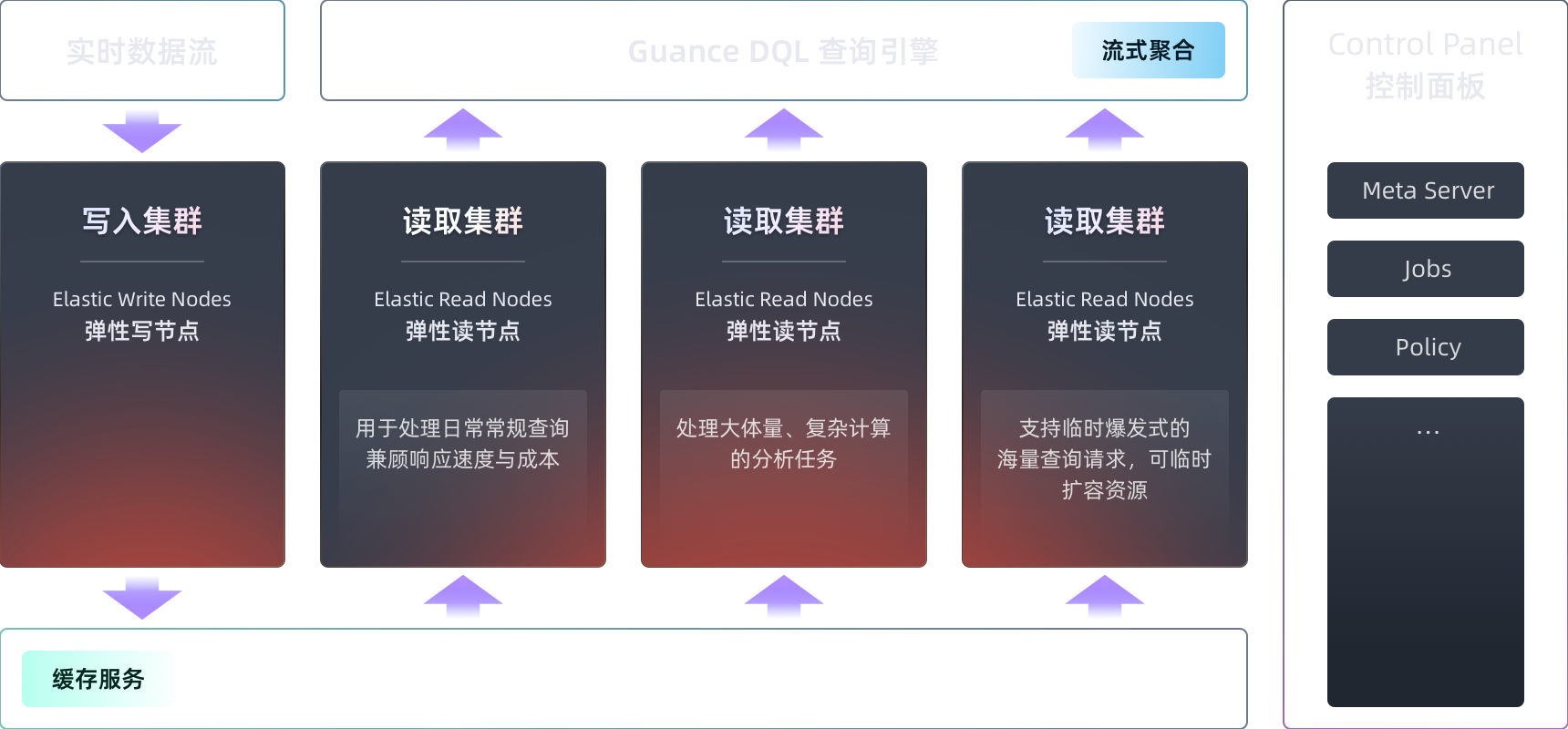
A fully separated storage engine for the AI era

It adopts integrated data lakehouse design and separation of storage-compute, allowing data storage and query computation to expand independently. The system leverages the elasticity of cloud infrastructure to adjust query resources according to business load and optimize resource costs according to different computing power types. For example, computing resources are expanded during weekday peak queries, and idle computing power is reduced during nights and weekends. Actual capacity, query concurrency, and elasticity range are subject to deployment specifications and service quotas.

GuanceDB 3.0 features a fully separated memory-compute architecture

Tailored to the needs of different enterprises

Through intelligent scheduling, multi-tenant optimization, and elastic computing power provision, GuanceDB 3.0 achieves a comprehensive evolution in performance, cost, and flexibility of the observable data processing architecture, helping enterprises efficiently build more cost-effective data infrastructure.

The system has built multi-level resource scheduling strategies based on different enterprise usage scenarios:

01. High cost-performance users

Priority is given to the use of shared computing pools, and idle computing power in the system can be flexibly called during peak periods to maximize resource reuse

02. Performance-sensitive users

Configure independent query computing clusters to ensure stable and fast response capabilities in any scenario

03. Small and medium-sized teams

Unified access to the shared pool, the system uses concurrency control mechanisms to ensure the query experience while keeping costs controllable

04. Users who prioritize storage

By adopting independent processing paths, computing resources are stripped, further reducing system load and cost

Brand new

Brand new streaming aggregation acceleration engine

When writing data, it automatically builds queries that need acceleration based on users' historical queries, and preaggregates data in minimal time shards. When the query finds that relevant data already has pre-aggregated results within the current time frame, it directly retrieves data from streaming aggregation rather than the original data.

Learn more
GuanceDB 3.0 streaming aggregation acceleration engine

Transparent acceleration

For indicators and log queries suitable for pre-aggregation, the business side does not need to rewrite existing dashboards and monitors; the system automatically reuses aggregated results

Any data time

Aggregate data based on the time marked by the data itself, and combine write and update mechanisms to handle delayed data reporting

Lower resource usage

Transfers high-frequency queries suitable for pre-aggregation to stream aggregation result responses, reducing the burden of repeated raw data scanning and database query pressure

Advantages of GuanceDB 3.0

Supports a wide range of business scenarios

Different read clusters can be provided for different business scenarios, using different configuration schemes (high concurrency, offline tasks, etc.) and isolating each separately

Real-time queries

Batch reports

Business analysis

Data Mining

GuanceDB 2.0 continues to serve

GuanceDB 2.0 The privatized version will continue to be served

FAQ

Frequently asked questions

What problems does GuanceDB mainly solve?

GuanceDB addresses the challenges of storing, querying, aggregating acceleration, and long-term retention of large-scale observable data, suitable for scenarios where logs, metrics, links, RUM, events, and business data continue to grow.

Why does GuanceDB use storage-compute separation?

Storage-compute separation allows storage and query resources to scale independently. Teams can adjust compute resources based on query peaks, long-term retention, and cost requirements without having to bind all data and compute into the same cluster.

What queries are suitable for streaming aggregation acceleration?

Stream aggregation acceleration is suitable for high-frequency dashboards, monitors, and fixed analysis paradigms. The system can build pre-aggregated results based on historical queries, reducing the cost of rescanning raw data each time.