

Contact us

Join the community

Scan with WeChat
Join the official community group

Try Guance

Start online with usage-based pricing and a true cloud service.

Get started

Choose a Guance edition

Code repositories

AI Agent Observability

AI Agent observability

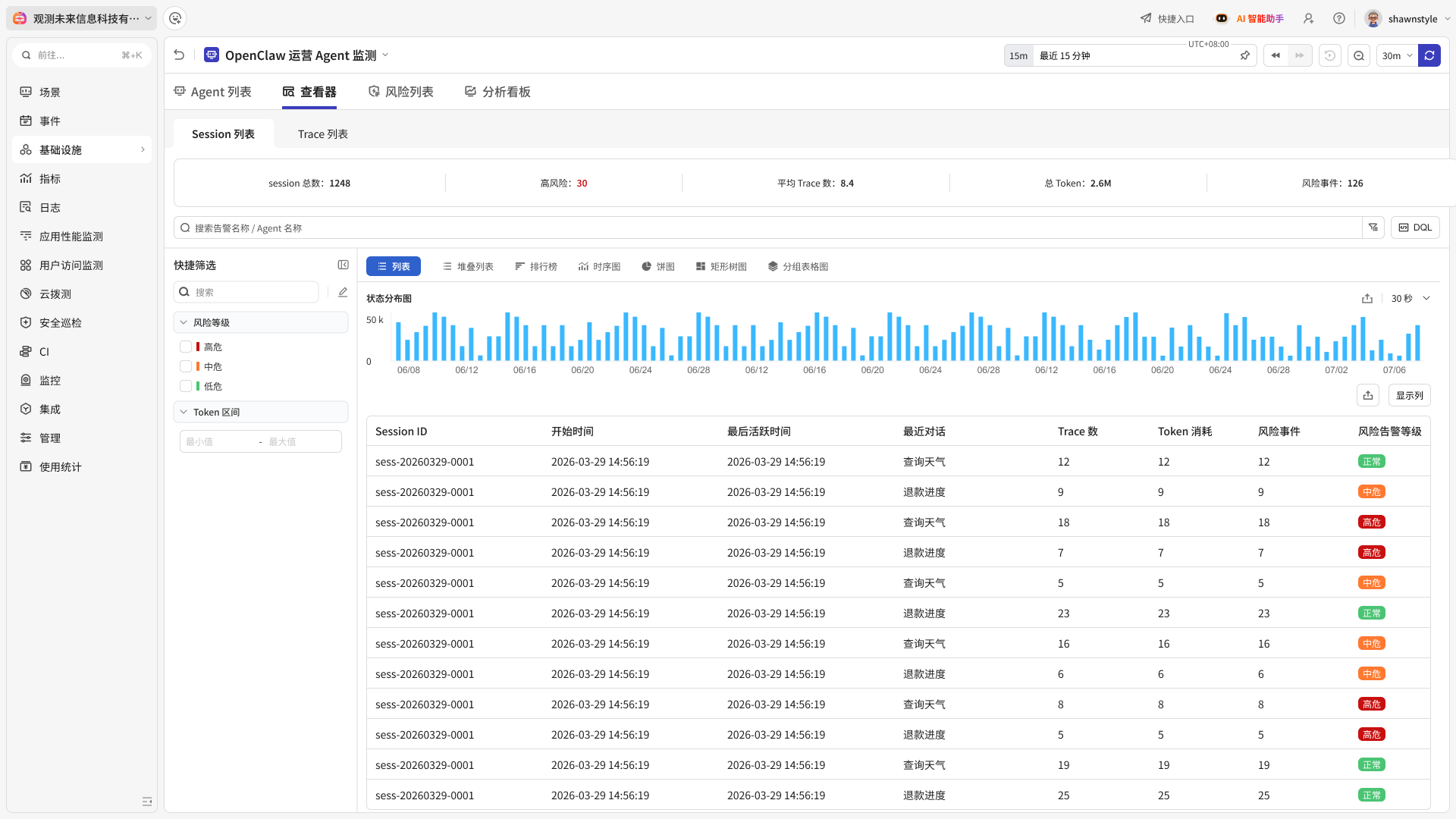
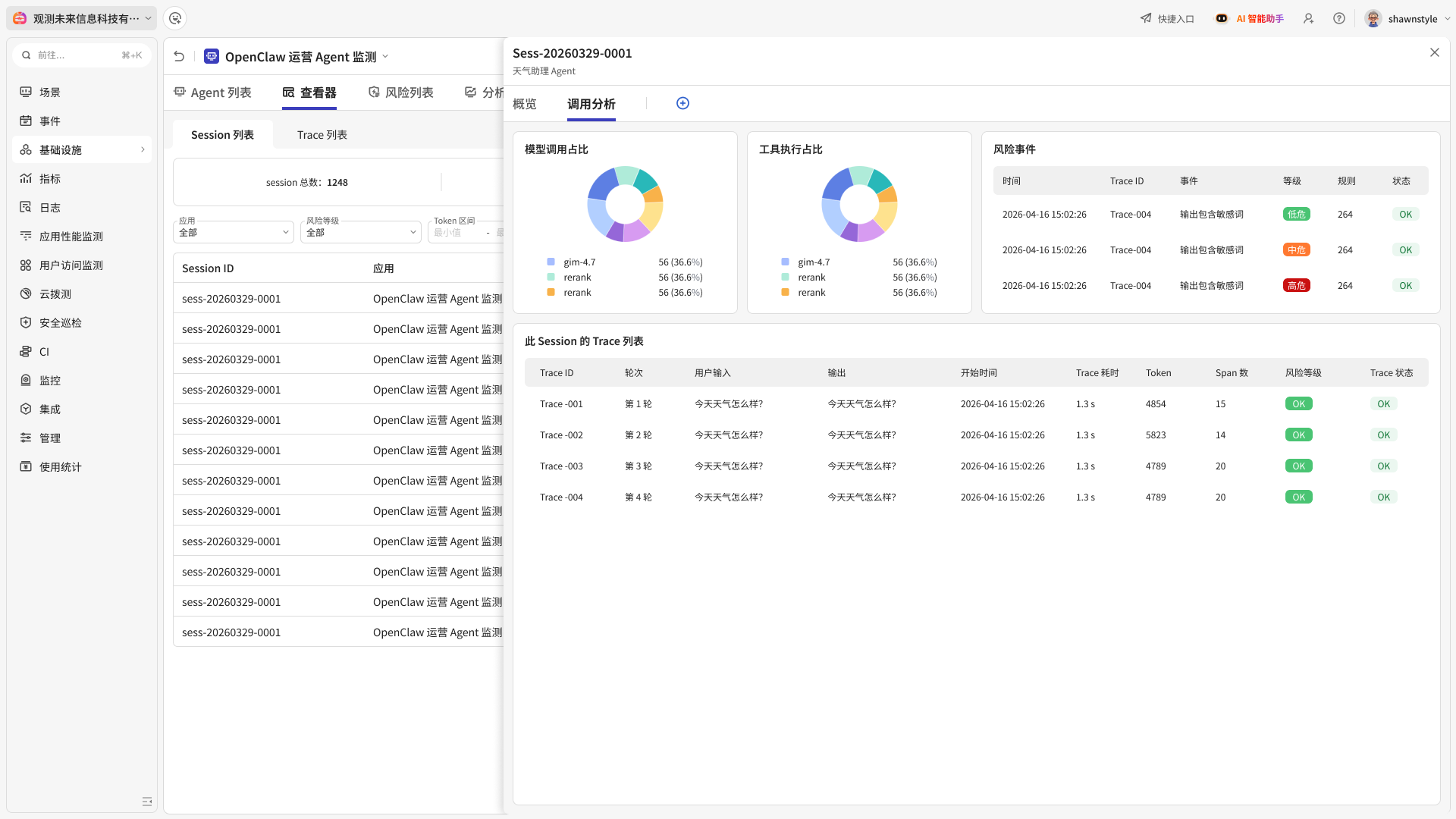
Guance AI Agent can observe AI Agent applications and LLM workflows, providing unified analysis of sessions, traces, spans, model calls, tool execution, token consumption, and risk events, helping teams identify issues such as slow response, high costs, call failures, and output risks in AI applications.

Solution Overview

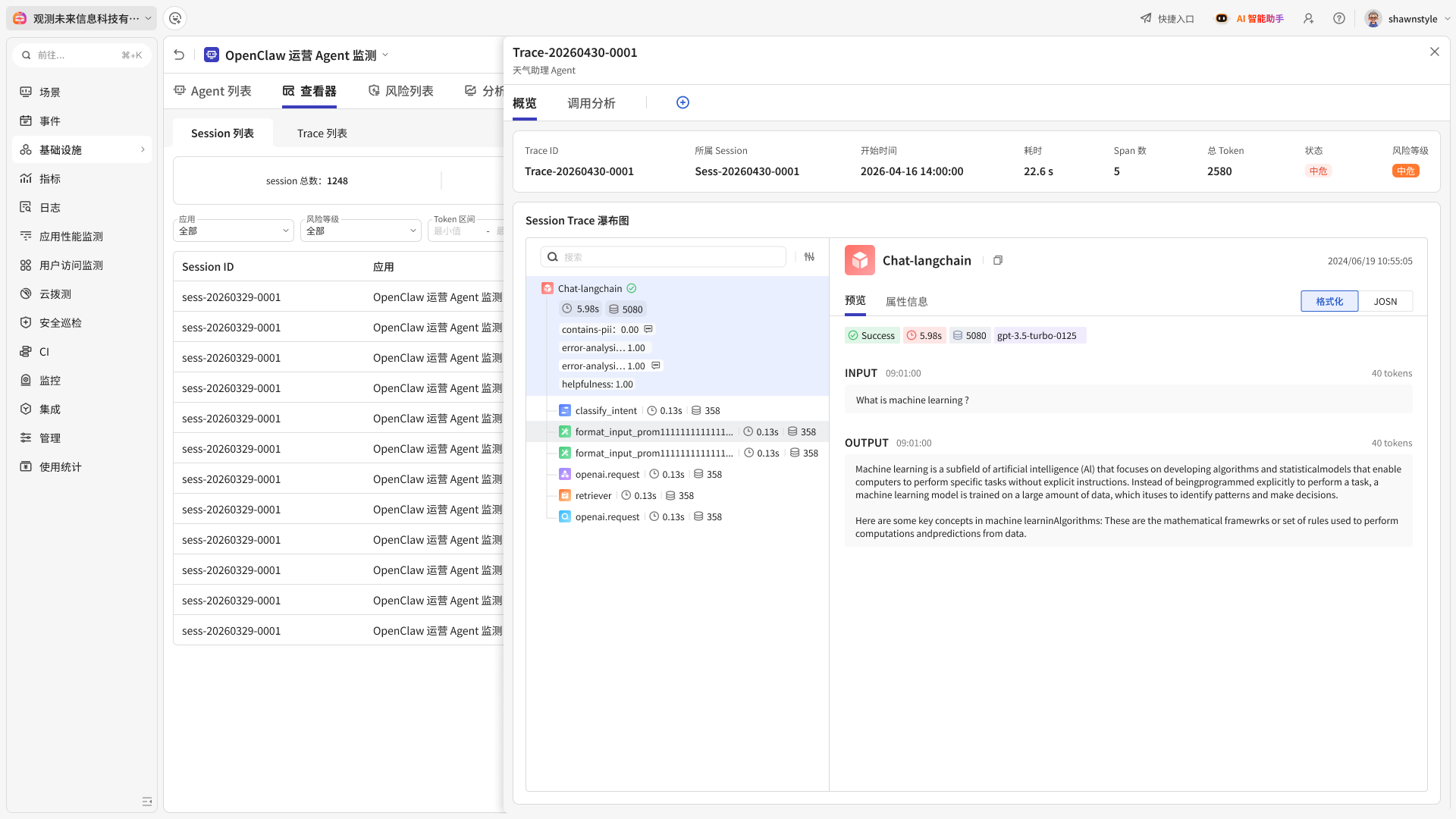
AI Agent observability focuses not only on whether the model interface is successful, but also on the relationships among prompts, completions, models, tools, tools, retrieval, Guardrail, and business chains within a AI Agent session. Guance put Session, Trace, Span, Token, time, and risk events into a single perspective, helping teams see what happens at every step of the AI Agent.

AI Agent can observe the AI Agent workflow of coverage

Establishing an observation context around multi-turn conversations, model calls, tool execution, token cost, and risk events, covering Agent/LLM access frameworks like OpenClaw, tool-invoking AI Agent workflows, and enterprise-custom AI Agent applications.

OpenClaw
Hermes
Claude Code
Codex
Other AI Agent

Scene challenge

AI Agent Execution Process Black Box:A single answer may go through multiple rounds of reasoning, tool calls, retrieval, and Guardrail, making it difficult for traditional links to explain what happens at every step.

Token cost and latency are difficult to control:Models, context length, tool retrys, and multiple rounds of calls all affect cost and response time, and without fine-grained data, optimization is difficult.

Risk events are difficult to locate:Sensitive words, content moderation, tool timeouts, and exception outputs need to be considered together with specific sessions, traces, and spar.

Disconnect between AI applications and business systems:AI Agent calls are only part of the business process and must be analyzed together with logs, metrics, links, and user behavior.

Guance plan

Session and Trace Tracing:Reconstruct the AI Agent execution process by session, turn, and call link, quickly identifying the slow, error, or high performance stages.

Model and Tool Call Analysis:Unified observation of model requests, tool execution, retrieval, time consumption, status, and risk level.

Token and Performance Cost Monitoring:Continuously analyzes token consumption, number of spans, trace time, and model call ratio to support cost optimization.

Risk event linkage positioning:Associate sensitive words, Guardrail, content moderation, and exception states with the specific call context.

Highlights of the solution

More content

Frequently asked questions

What is the difference between AI Agent observability and LLM observability?

LLM observability focuses more on model calls, prompts, tokens, response time, and the application chain of large models; AI Agent observability further revolves around AI Agent sessions, multi-turn traces, tool execution, risk events, and call analysis, suitable for AI applications with tool orchestration, retrieval, Guardrail, or multi-step inference.

What key indicators can AI Agent observable be observed?

Common metrics include session count, number of traces, trace time, number of spans, token consumption, model call ratio, tool execution ratio, number of risk events, risk level, and call status. Teams can use these metrics to assess experience, stability, cost, and security risks.

How can AI Agent observable be connected to AI Agent applications?

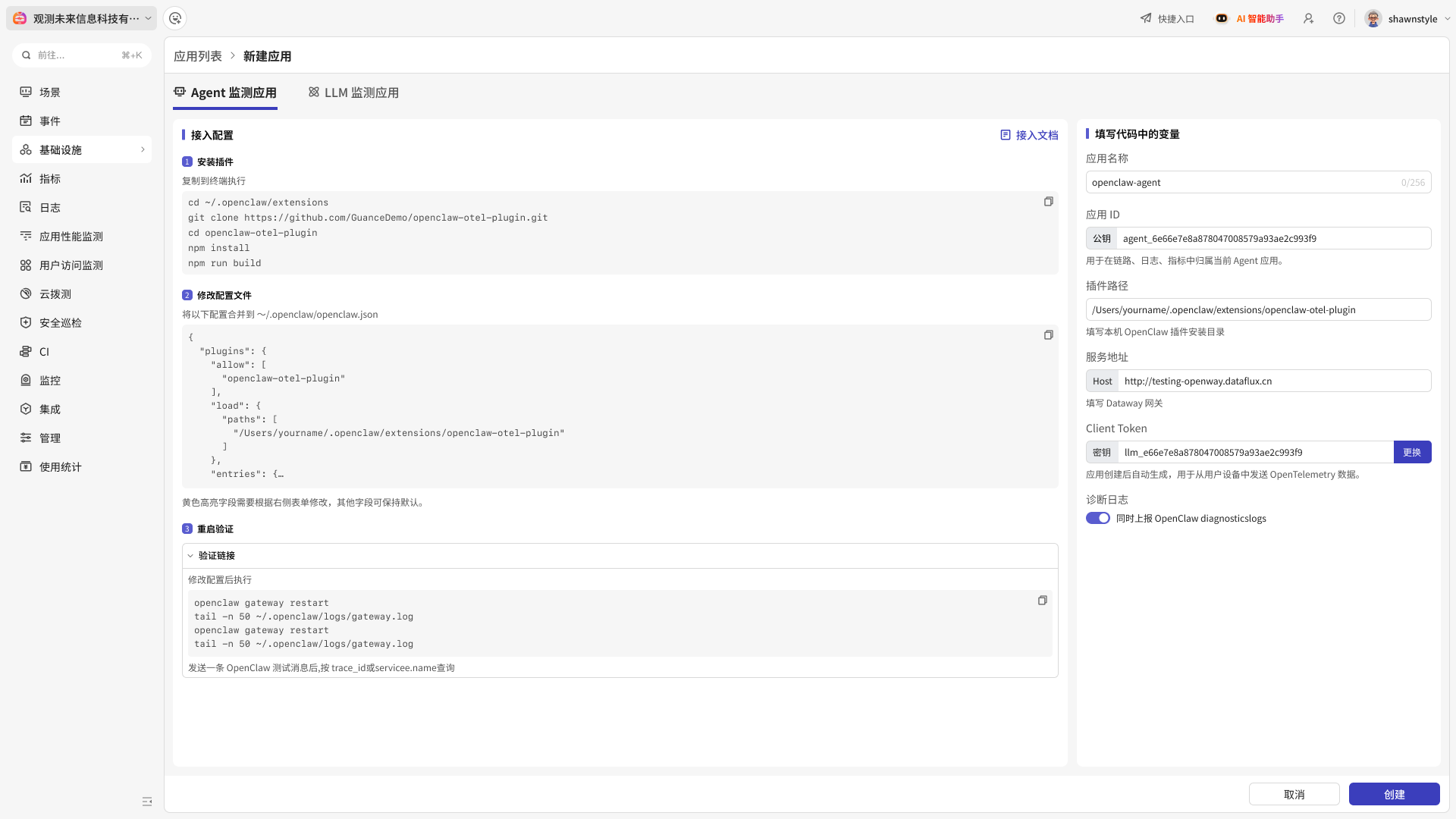
Teams can create Agent monitoring applications or LLM monitoring applications Guance, obtain application IDs, service addresses, and Client Tokens, and complete configuration according to the access documentation. After data is reported, the viewer analyzes and runs the process by Session, Trace, Token, risk level, and application dimension AI Agent the process.

Which teams is AI Agent observable suitable for?

It is suitable for R&D, algorithm, AI platform, SRE, and security governance teams, especially those already operating AI Agent, customer service assistants, operations Agent, RAG applications, or tool-based AI workflows.

Related reading

Want to see how your AI Agent call chain is fully observed?

Contact sales