Contact us

Join the community

Scan with WeChat
Join the official community group

Try Guance

Start online with usage-based pricing and a true cloud service.

Get started

Choose a Guance edition

Code repositories

Log Management

Log management platform and log governance

Guance log management platform covers log indexing, storage and retention policies, permission anonymization, pipeline parsing, blacklist filtering, log forwarding, and audit tracking, helping platforms, operations, and security teams control costs, improve log analysis efficiency, and meet compliance governance requirements throughout the entire log lifecycle.

Log management platform and log governance
Book a demo

Previously, we were very passive in data analysis, lacking real-time analysis capabilities and a unified log management platform. Since introducing Guance's log management solution, we have finally been able to centrally process, unify retrieval, and structure all log data, truly turning log resources into value that can be continuously uncovered.

———— Zhang Haowei Director of Operations at Linqu Intelligent

What problems does log management solve?

Make massive logs accessible, controllable, and manageable, rather than just keeping them and becoming more expensive

As log size grew, the team faced not only query issues but also index bloat, field confusion, permission boundaries, sensitive data, archiving and retention, external forwarding, and storage costs. Guance log management platform focuses on full lifecycle log governance, keeping logs controllable from collection, parsing, storage, access to forwarding.

Are logs getting more expensive the more you store them? First, use indexing and storage strategies to control costs
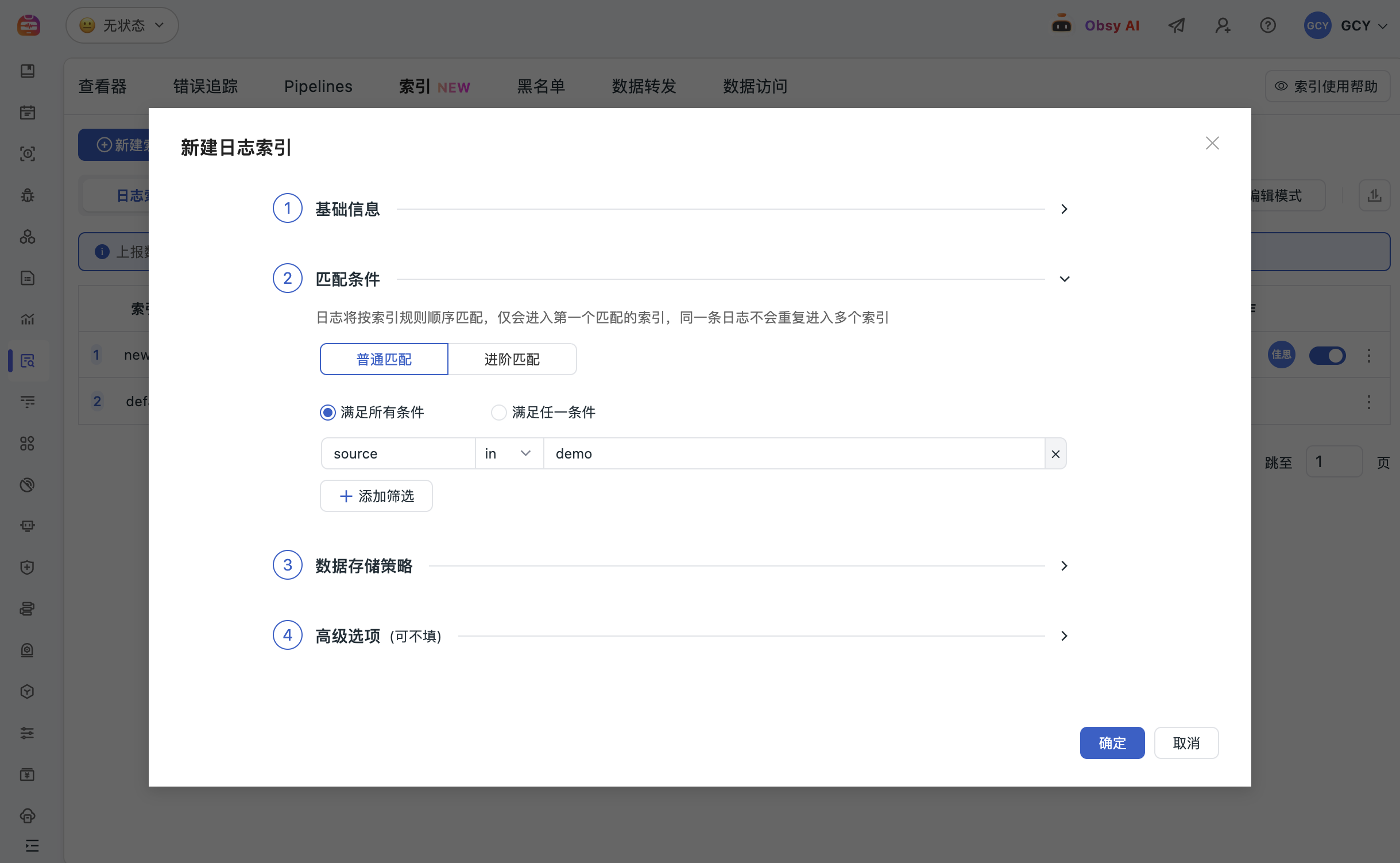
The log management platform supports custom index names, filtering criteria, storage retention cycles, and archiving strategies. Teams can plan indexes based on business lines, environments, log types, or importance levels, keeping high-value logs efficient for querying and low-frequency logs entering more suitable retention strategies, balancing cost, query efficiency, and audit needs at the source.
Are logs getting more expensive the more you store them? First, use indexing and storage strategies to control costs
Not everyone should view all logs; permissions and desensitization must be done together
Through role permissions, data access scope, and desensitization rules, teams can control which logs different members can view and which fields need to be hidden. For mobile numbers, ID numbers, tokens, keys, and business-sensitive fields, log management can be combined with desensitization strategies to reduce data breaches and compliance risks.
If the fields are not unified, analysis is difficult, so log structures are managed using Pipeline
Log management supports multi-source log access from containers, hosts, Kubernetes, applications, and middleware, and extracts key fields like service, host, status, trace_id, user_id, order_id through pipeline parsing scripts. Once fields are standardized, logs can be reliably used for retrieval, aggregation, alerting, and contextual association.
If the fields are not unified, analysis is difficult, so log structures are managed using Pipeline
Low-value logs filling up storage? Use filtering rules to reduce noise
Based on blacklists, field conditions, and collection strategies, teams can filter duplicate, invalid, or low-value logs to avoid noise that occupies storage resources and interferes with query results. For high-concurrency businesses, log filtering is also an important means to control costs and improve the retrieval experience.
Logs should also be used by external systems, and forwarding and auditing must be traceable
Logs can be forwarded to external storage, data platforms, or security systems to meet archiving, auditing, offline analysis, and multi-system collaboration needs. Changes in indexing, filtering, forwarding, permissions, and desensitization configurations should also be recorded to facilitate platform teams in tracking governance actions and compliance audits.
Logs should also be used by external systems, and forwarding and auditing must be traceable

Frequently asked questions

What is the difference between log management and log monitoring?

Log monitoring focuses more on log queries, analysis, association, and alerts; Log management focuses more on full lifecycle log governance, including indexing, storage, permissions, anonymization, parsing, filtering, forwarding, and auditing.

How can log management reduce log costs?

Teams can reduce unnecessary write, storage, and query overhead through index planning, storage and retention policies, blacklist filtering, field governance, and low-value log denoising, while retaining critical log retrieval and auditing capabilities.

How does log management protect sensitive data?

Guance supports protection of mobile phone numbers, ID numbers, tokens, keys, and business-sensitive fields in logs through permission control, sensitive field identification, desensitization rules, and access scope management.

What role does Pipeline play in log management?

Pipeline can perform field extraction, format standardization, data cleaning, and desensitization before logs enter the platform or during the analysis process, making logs easier to query, aggregate, alert, and analyze correlations.

Explore more

Resources and further reading

Choose the next step from product documentation, related solutions, and technical guidance.

Related reading

Selected product practices, troubleshooting guidance, and technical solutions

Best practices for collecting business logs in the host environment

Best practices for collecting business logs in the host environment

This paper aims to combine the characteristics of current host environment business and achieve unified log query and analysis results by Guance best practices for collecting host environment business logs. It helps users understand how to effectively collect, store, analyze, and disperse log data, providing strong support for improving the efficiency of log collection and analysis.

Best practices
Best practices for scanning and desensitizing log-sensitive data

Best practices for scanning and desensitizing log-sensitive data

This article will explore the applications of sensitive data scanning and desensitization, analyzing their importance in preventing data breaches, complying with laws and regulations, and maintaining corporate reputation, aiming to provide valuable references and solutions for enterprises in the field of data security.

Best practices Going out to sea
Logstash business log access observes best practices

Logstash business log access observes best practices

The main purpose of this article is to explore how to use Logstash's tools to simultaneously collect and transform data from multiple sources, and ultimately upload this data to Guance. Through the Guance platform, we can collect and display data, thereby building a comprehensive system for log querying, storage, and analysis.

Best practices
Pipeline helps you easily manage massive amounts of data!

Pipeline helps you easily manage massive amounts of data!

Data governance has become crucial in today's information age. As the volume of data continues to grow and diversify, organizations need to effectively manage and utilize this data to support business decisions and innovative development. Whether for data analysis or parsing, using Pipeline helps organizations automate and standardize data governance; Providing organizations with clearer and more actionable data views to strongly support data governance.

Product capabilities

Want to see how a log management platform is integrated into your business system?

Book a demo