GuanceDB / Observability Data Engine

GuanceDB3.1

Observability data infrastructure for the AI era

GuanceDB 3.1 now supports data storage and analytics at greater scale, laying a solid foundation for our continued business growth.

Wu Hongqin · CTO, Meiyijia

Pain points

Observability is evolving, but the underlying systems are stuck in the past

As business evolves, the data accessed by the observability platform is no longer limited to basic monitoring metrics, but also includes application logs, links, user experience, and business data. As data scale, query concurrency, and retention cycles continue to grow, traditional architectures tightly coupled with computing and storage tend to encounter bottlenecks in scaling efficiency and resource utilization.
Dashboards, monitors, and day-to-day troubleshooting generate large volumes of repeated queries. GuanceDB 3.1 uses purpose-built engines and streaming aggregation to identify query patterns that can be accelerated, reduce repeated scans of raw data, and schedule query resources according to actual load.


Upgrade

Traditional MPP architecture vs. GuanceDB 3.1

This comparison shows how GuanceDB 3.1 separates storage from compute, allowing query resources to scale independently with workload and providing greater flexibility across performance, cost, and resource isolation.

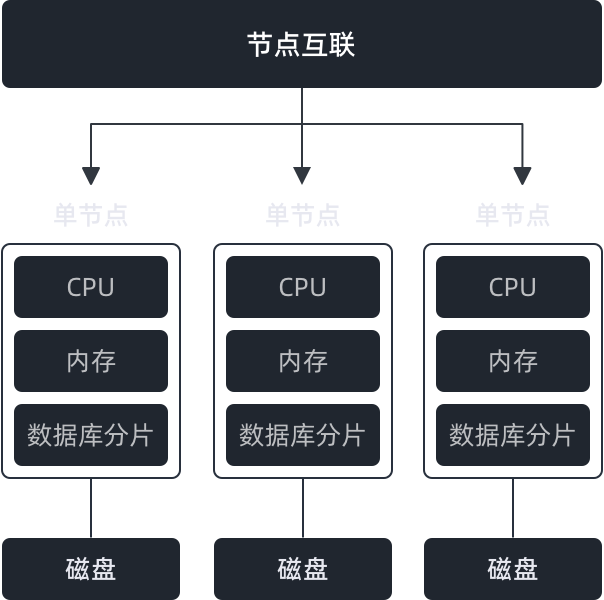
Traditional MPP architecture

Computing and storage are tightly coupled, with limited scalability. Computing resources are difficult to adjust dynamically, overall utilization is low, and expansion costs are high.

Traditional MPP architecture

A fully separated storage engine for the AI era

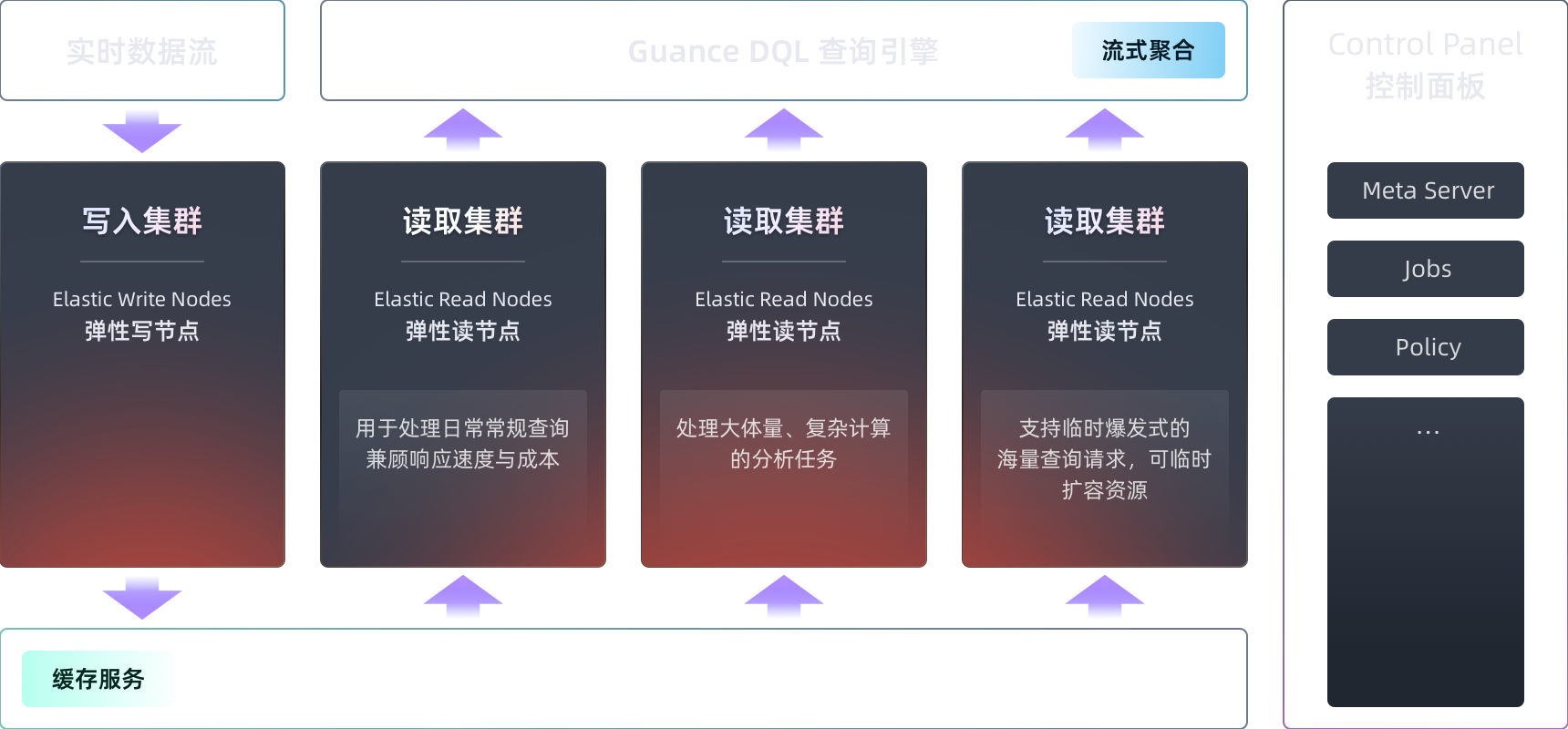
It adopts integrated data lakehouse design and separation of storage-compute, allowing data storage and query computation to expand independently. The system leverages the elasticity of cloud infrastructure to adjust query resources according to business load and optimize resource costs according to different computing power types. For example, computing resources are expanded during weekday peak queries, and idle computing power is reduced during nights and weekends. Actual capacity, query concurrency, and elasticity range are subject to deployment specifications and service quotas.

GuanceDB 3.1 fully separated storage and compute architecture

Tailored to the needs of different enterprises

With dual engines, intelligent scheduling, multi-tenant optimization, and elastic compute, GuanceDB 3.1 advances observability data processing across performance, cost, and flexibility, helping enterprises build a more efficient data foundation.

The system has built multi-level resource scheduling strategies based on different enterprise usage scenarios:

01. High cost-performance users

Priority is given to the use of shared computing pools, and idle computing power in the system can be flexibly called during peak periods to maximize resource reuse

02. Performance-sensitive users

Configure independent query computing clusters to ensure stable and fast response capabilities in any scenario

03. Small and medium-sized teams

Unified access to the shared pool, the system uses concurrency control mechanisms to ensure the query experience while keeping costs controllable

04. Users who prioritize storage

By adopting independent processing paths, computing resources are stripped, further reducing system load and cost

3.1 upgrade

Dual-engine routing sends each data type down the right path

Metric Engine is built for high-cardinality time series, while Event Engine handles logs, traces, RUM, security events, and AI Agent Events. GuanceDB 3.1 routes data by model during ingestion, then exposes a unified query interface through DQL and Query Router.

GuanceDB 3.1 dual-engine routing architecture with Metric Engine and Event Engine

Purpose-built metrics engine

Optimized storage and query paths for time windows, long-term trends, and high-cardinality metrics

Purpose-built event engine

One engine for Logs, Traces, RUM, Events, and AI Agent Events

Unified query interface

DQL and Query Router schedule compute by workload while preserving a consistent user experience

3.1 upgrade

A purpose-built inverted index turns full scans into direct lookup

Event Engine maps terms to records as logs are ingested. Full-text queries locate matching records through the index before reading the relevant data, avoiding repeated scans of raw text and reducing compute and storage amplification.

GuanceDB 3.1 inverted-index workflow from log ingestion to full-text query

Build the index on ingest

Map terms to record locations during ingestion instead of scanning when a query arrives

Locate before reading

Use the index to identify matching ranges first, then read only the required data

Native to Event Engine

Shares a unified data and compute path with filters, field search, and DQL queries

Acceleration

Streaming aggregation acceleration engine

As data is ingested, the system uses historical query patterns to identify workloads that benefit from acceleration and pre-aggregates data into small time windows. When a matching aggregate exists for the requested range, queries read it directly instead of scanning raw data.

Learn more
GuanceDB 3.1 streaming aggregation acceleration engine

Transparent acceleration

Existing dashboards and monitors require no changes; eligible metric and log queries automatically reuse aggregate results

Event-time aware

Aggregates by the timestamp carried in the data and handles late arrivals through ingestion and update mechanisms

Lower resource usage

Serves eligible high-frequency queries from streaming aggregates to reduce repeated raw-data scans and database pressure

Why GuanceDB 3.1

Supports a wide range of business scenarios

Different read clusters can be provided for different business scenarios, using different configuration schemes (high concurrency, offline tasks, etc.) and isolating each separately

Real-time queries

Batch reports

Business analysis

Data Mining

GuanceDB 2.0 continues to serve

GuanceDB 2.0 The privatized version will continue to be served

FAQ

Frequently Asked Questions

What is GuanceDB 3.1?

GuanceDB is the Guance data engine for observability workloads. This page covers Metric Engine, Event Engine, inverted indexing, streaming aggregation, and shared query access. Confirm component availability against the current deployment version and service specification.

How do Metric Engine and Event Engine differ?

Metric Engine is designed for time-series and PromQL-oriented queries. Event Engine is designed for field filtering and full-text retrieval across detailed logs, traces, RUM, and event records. Supported data types and component combinations depend on the deployed version.

Does streaming aggregation replace raw-data queries?

No. Only eligible queries with a matching maintained aggregate use that path. Other queries still execute against raw data. Teams should validate eligibility with their actual dashboards and monitors.

What capacity and query concurrency does GuanceDB provide?

Capacity, retention, concurrency, and elasticity depend on deployment topology, version, service specification, and quota. Use the current deployment documentation and a formal workload review instead of inferring a fixed result from the architecture diagram.