Contact us

Join the community

Scan with WeChat
Join the official community group

Try Guance

Start online with usage-based pricing and a true cloud service.

Get started

Choose a Guance edition

Code repositories

Synthetic Monitoring

API availability monitoring and dial-up testing

Guance API availability monitoring continuously verifies the reachability of websites, API interfaces, domain names, and critical services from global detection nodes through HTTP, TCP, ICMP, WebSocket, DNS, SSL, and other dial-up tasks, helping SRE, operations, and R&D teams detect access failures, interface timeouts, and network quality issues before users do.

API availability monitoring and dial-up testing
Book a demo

API availability monitoring addresses what issues it addresses

Continuously verify from external access paths whether the website and API are truly available

Just because a service appears normal on the internal network does not necessarily mean users can access it; APIs may also timed out in certain regions, carriers, or dependent links. API availability monitoring simulates real access paths through distributed dial-up testing, continuously checking sites, interfaces, DNS, SSL, ports, and network quality, helping teams detect unreachability, slow response, parsing failures, and regional access issues before user complaints.

Can users really access it? Continuously verify reachability with multi-protocol dial testing
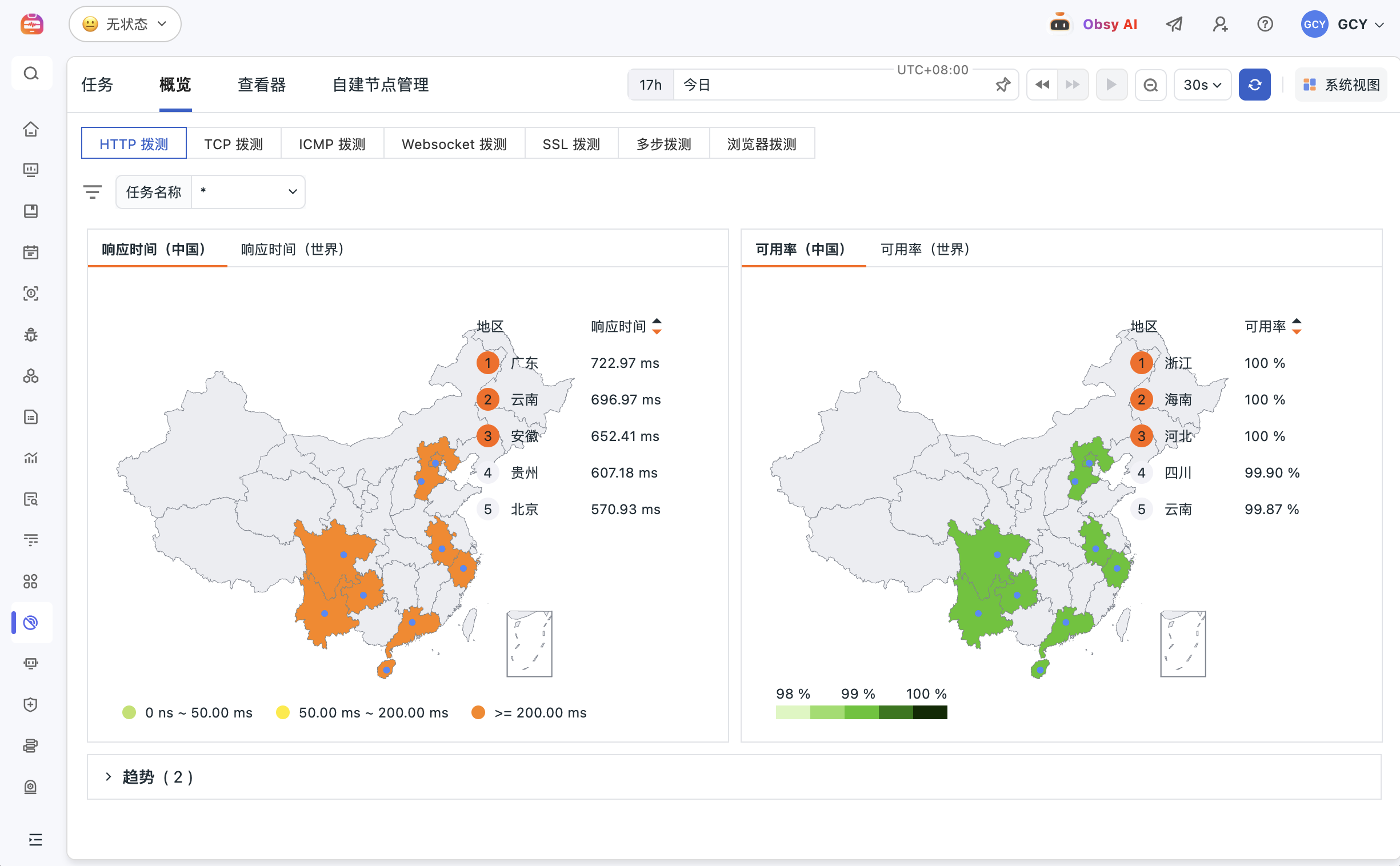
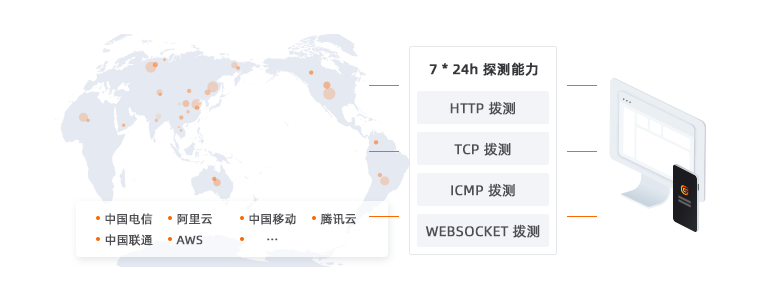
By creating HTTP, TCP, ICMP, WebSocket, DNS, and SSL detection tasks distributed globally, simulating access to websites, domain names, backend API interfaces, and key services. Teams can continuously monitor website monitoring, API monitoring, response times, and failure rates across different regions and operators.
Can users really access it? Continuously verify reachability with multi-protocol dial testing
Where does access failure occur? Locate by location, carrier, and error cause
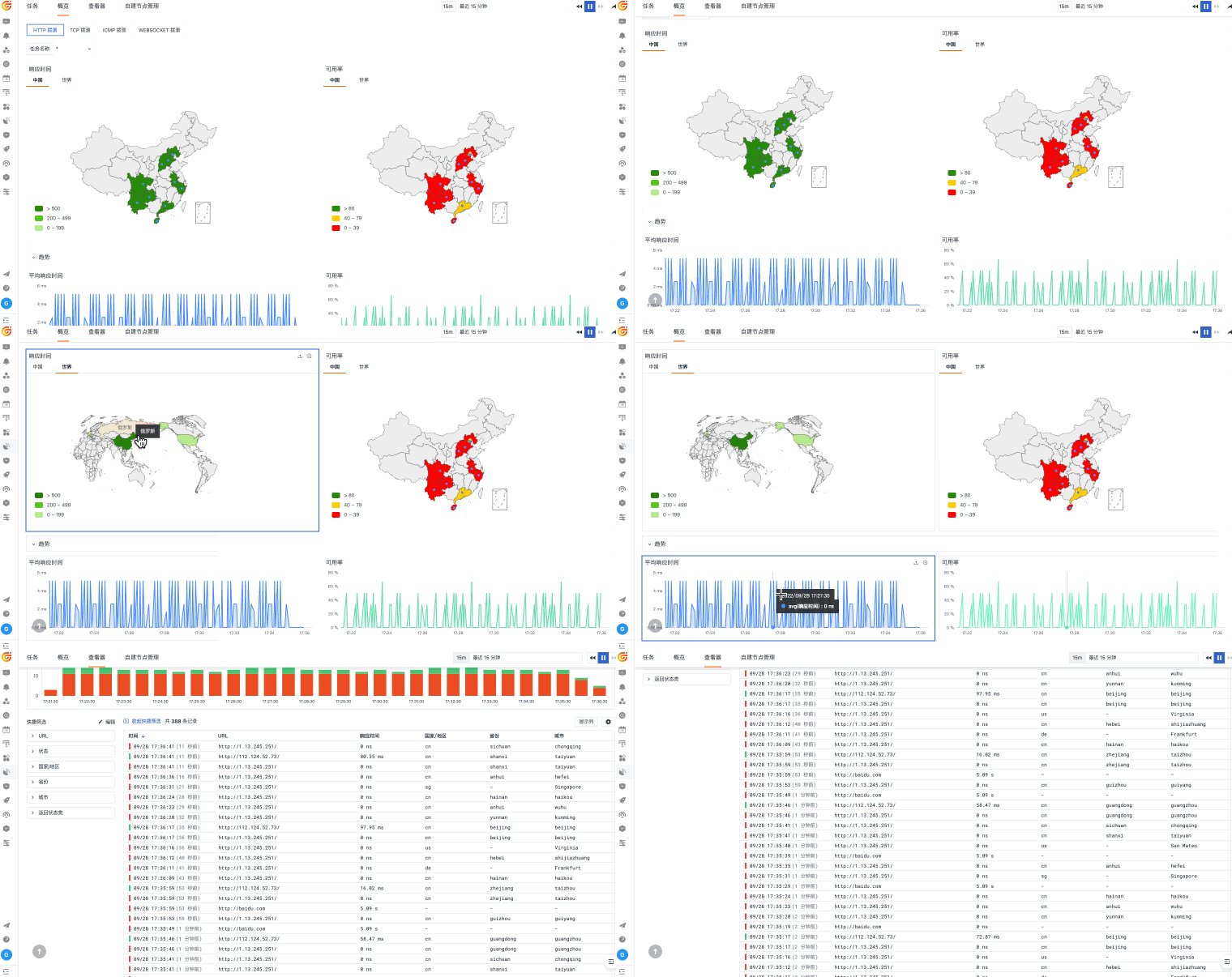
API availability monitoring records the response details of each call test, failure reasons, and performance data, including DNS resolution, SSL handshakes, TTFB, response codes, timeouts, and network errors. Teams can determine from maps, trends, and details whether the issue is a global failure, a regional network issue, or a server configuration anomaly.
Failure depends not only on status codes but also on DNS, SSL, response time, and network links
A single dial-up failure may be caused by DNS resolution, certificate expiration, network timeout, server errors, abnormal response codes, or content validation failures. Guance retain this diagnostic information to help teams bridge the gap from "access failure" to "knowing the cause of failure."
Failure depends not only on status codes but also on DNS, SSL, response time, and network links
Include site, domain, CDN, and interface availability in unified alerts
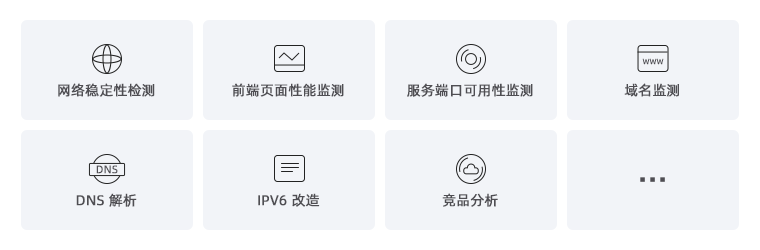
Availability monitoring is suitable for scenarios such as website monitoring, API monitoring, service port monitoring, network dial-up, domain name and DNS resolution verification, IPv6 transformation, CDN quality monitoring, and overseas access quality verification. Exceptions can be accessed via monitoring alerts and event centers, helping teams detect and respond to users ahead of others.

Frequently asked questions

What is API availability monitoring?

API availability monitoring verifies service reach, response normal, and access performance by periodically detecting external nodes to websites, API interfaces, domain names, or ports. It is commonly referred to as dial detection, synthetic monitoring, or network dial detection.

What do API availability checks and API availability detection usually check?

API availability checks typically continuously check whether interfaces are reachable, whether response codes are correct, whether DNS and SSL are normal, whether response times are overdue, and whether there are network quality differences when accessing the same interface from different regions or operators.

Which protocols does API availability monitoring support?

Guance API availability monitoring supports common protocols such as HTTP, TCP, ICMP, WebSocket, DNS, and SSL, suitable for websites, APIs, service ports, domain name resolution, and network quality verification.

What is the difference between API availability monitoring and RUM?

API availability monitoring is proactive auditing used to continuously verify external service accessibility; RUM is Real User Experience Monitoring, used to analyze page performance, errors, and behavior paths during real visits. The combination of both can simultaneously cover active validation and real-world experiences.

How does API availability monitoring help with fault response?

When dialing fails or responses slow down, Guance can record the cause of failure, location, and operator information, triggering alerts or events to help teams quickly assess the impact and locate DNS, SSL, network, or server issues.

Explore more

Resources and further reading

Choose the next step from product documentation, related solutions, and technical guidance.

Related reading

Selected product practices, troubleshooting guidance, and technical solutions

Want to see how API availability monitoring is being implemented in your business systems?

Book a demo