Customer background
Peet's Coffee is a coffee brand originating from the United States, specializing in high-quality coffee beans and unique roasting methods. Since entering the Chinese market in 2017, it currently has over 170 stores covering major cities such as Beijing, Shanghai, Guangzhou, and Chengdu.
In addition to offline stores, Peet's Coffee also promotes high-quality coffee products to the Chinese market through its official mall, e-commerce platforms, and partnerships with well-known coffee brands, offering consumers more choices.
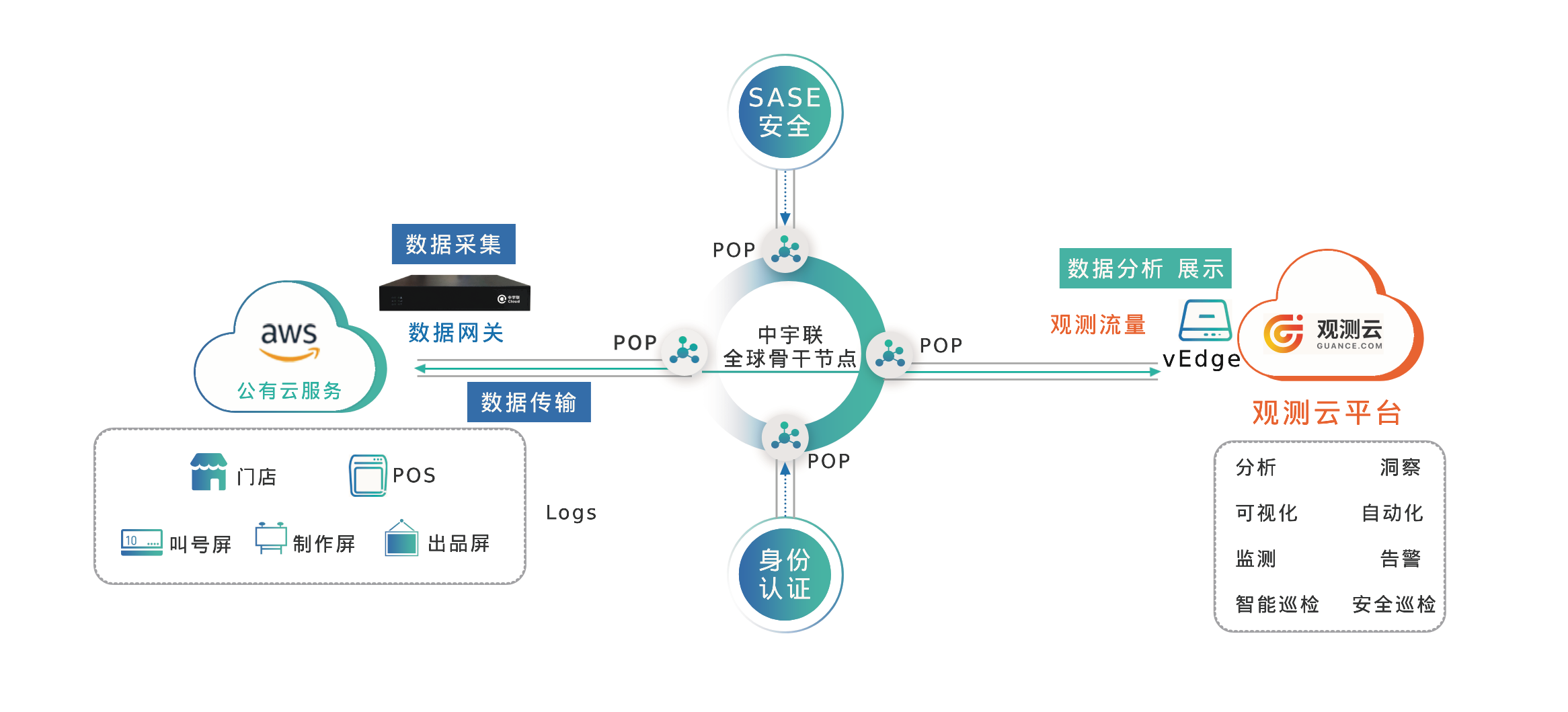
Pi Ye Coffee's current IT architecture is a hybrid cloud architecture, with IDC and AWS infrastructure environments respectively, and connects IDC, AWS, stores, Office, and mobile office personnel via SD-WAN. Store operations, log analytics, and third-party service positioning all require more unified observability capabilities.
The hybrid cloud and store chain span multiple environments
The business access link involves IDC, AWS, stores, Office, and mobile office scenarios, so it is necessary to unify the invocation relationships among networks, applications, and business systems during inspection.

Cloud log storage and management are relatively expensive
Stores and online businesses continue to generate large volumes of logs, and without a unified log analysis platform, the costs of storage, management, and manual analysis will keep rising.

Third-party service anomalies stem from difficulty in locating
Some services rely on third-party services, so when errors occur, it is necessary to quickly link application performance, logs, and error details; otherwise, the problem identification chain will be extended.

Solutions
Automatically plotting application link topology through data gateway access Guance
Through data gateway access Guance, Piye Coffee automatically plots the application link topology, displays call relationships, and further analyzes error rates and response times between service calls.
Teams can understand business access links around a single topology, pinpointing anomalies from stores, cloud resources, and application call relationships.
For third-party services, the association redirects to error details
For third-party services, Guance APM application performance monitoring not only allows for anomaly statistics but also direct linkage and jumps to obtain error details.
R&D and operations teams can more quickly determine whether issues originate from external dependencies, interface calls, or internal application logic, shortening root cause identification time.
Unified log analysis reduces manual analysis workload
Guance log analysis platform centrally accesses, retrieves, and analyzes business logs, reducing the time and workload of manual log analysis.
When anomalies occur in stores, POS, or online operations, teams can correlate logs with application chain and infrastructure status for analysis.
Customer outcomes
Cloud log storage and management costs reduced by about one-third:
By centrally managing log data through Guance log analysis platform, Pi Ye Coffee reduces cloud log storage and management costs while also lowering the investment of manual log analysis.

Problem localization efficiency improves by at least 50%:
Guance APM application performance monitoring helps teams quickly pinpoint root causes, allowing R&D and operations to collaborate on the same platform for troubleshooting, improving application stability.

Clearer hybrid cloud and store chains:
Key data from IDC, AWS, stores, Office, and mobile office scenarios is unified and linked, allowing teams to gain a more intuitive view of the business access chain.

Third-party service inspections are more direct:
After linking APM application performance monitoring with error details, teams can quickly identify third-party dependencies, reducing cross-system communication and repeated verification.